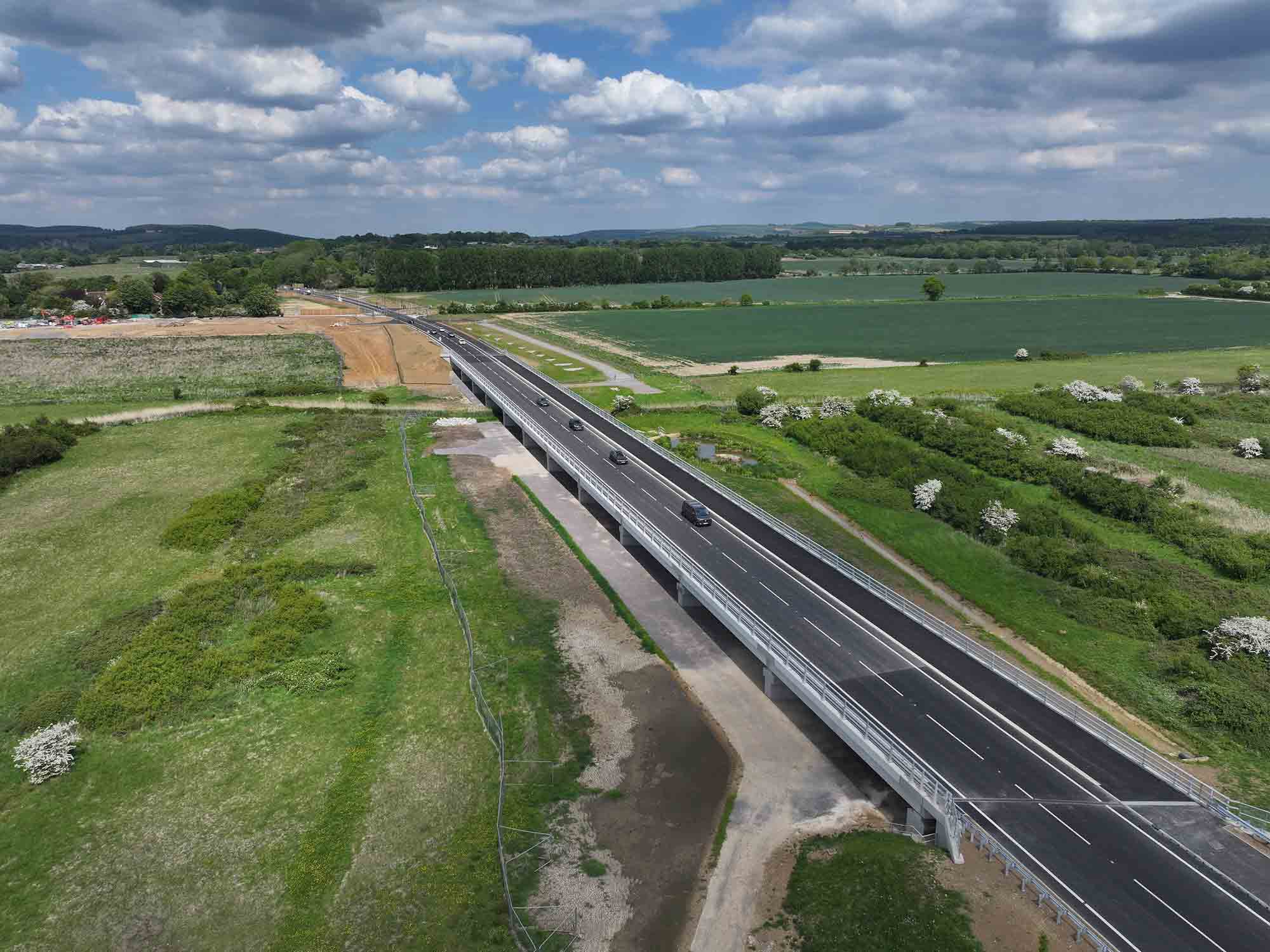
The Lyminster Bypass, of which Jackson designed and constructed the northern section on behalf of West Sussex County Council, has been officially opened.
The council’s Cabinet Member for Highways and Transport, Councillor Joy Dennis cut the ribbon on the new 1.8 kilometre-long road, which will significantly reduce journey times to and from Littlehampton and Bognor Regis on the South Coast.
The council’s Cabinet Member for Highways and Transport, Councillor Joy Dennis cut the ribbon on the new 1.8 kilometre-long road, which will significantly reduce journey times to and from Littlehampton and Bognor Regis on the South Coast.
The northern section features a 225-metre viaduct which crosses a flood plain. It required 96 foundation piles drilled through soft ground into the chalk base to support 121 horizontal concrete beams, each weighing up to 55 tonnes.
During construction, an area of poor-quality soil was discovered that could have cost £4 million to remove, but £2.7 million was saved by using a soil mixing technique to improve the strength of the underlying structure.
We’re delighted that the new bypass is open to traffic. It’s going to dramatically reduce the volume of traffic travelling through Lyminster and Wick villages and will make it much easier to get to and from Littlehampton for walkers and cyclists as well as drivers.
Joy Dennis – West Sussex County Council
This is a great day for West Sussex. The Lyminster Bypass is a brilliant example of how strategic infrastructure investment supports communities, unlocks new housing, and helps local economies thrive. I’m pleased that support will not only improve travel but will do so with real care for the environment and safety of all road users.”
Lilian Greenwood – Future Roads Minister
Design and construction
Jackson’s Director for the Southern Region, Steve Horton, said: “One of the most significant challenges of working on this floodplain was the structure of the underlying soils.
“This area is made up of ancient riverbeds that have silted up over time. The design and construction involved the implementation of various techniques to consolidate and strengthen the soils so that the road can be properly maintained in the future.”